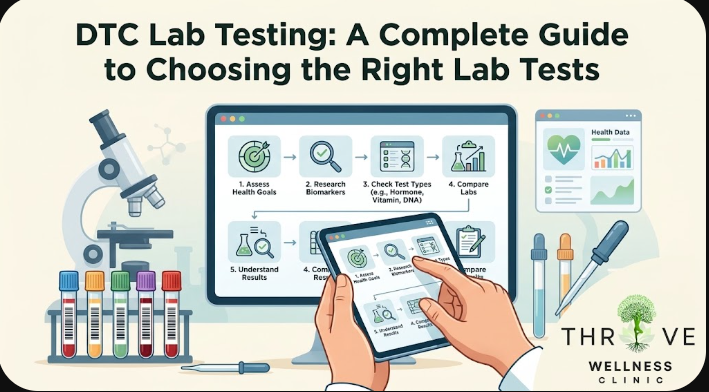
Many people want a more convenient way to understand their health without waiting for a traditional office visit before getting certain laboratory tests. Direct-to-consumer testing can provide access to selected lab tests and health information, but choosing the right test requires understanding what it measures, why it may be useful, and how the results should be interpreted.
DTC lab testing gives people another way to explore specific health concerns and monitor certain aspects of their wellness. This guide explains how direct-to-consumer laboratory testing works, which factors to consider when selecting tests, how results should be viewed, and why professional guidance can be important when making healthcare decisions.
What Is DTC Lab Testing?
DTC lab testing, or direct-to-consumer lab testing, refers to laboratory testing that people can access without necessarily obtaining a traditional referral from a healthcare provider. Depending on the testing service and local requirements, individuals may order specific tests, provide a blood or other biological sample, and receive laboratory results for review.
The availability of DTC lab testing varies by location and by the type of test being requested. Some tests may evaluate general wellness markers, while others can provide information related to areas such as metabolic health, cholesterol, blood sugar, thyroid function, vitamins, or hormones.
Why Do People Choose Direct-to-Consumer Testing?
Convenience is one of the main reasons people consider consumer-accessible laboratory testing. Someone who wants to monitor a known health marker or learn more about a particular concern may appreciate having additional options for accessing laboratory services.
DTC lab testing may also appeal to people who want to become more proactive about their health. However, ordering a test simply because it is available does not always mean it is medically necessary. The usefulness of a result depends on the individual's symptoms, health history, medications, risk factors, and other clinical information.
Common reasons people consider testing include:
- Monitoring previously identified health concerns
- Checking certain wellness or metabolic markers
- Discussing persistent symptoms with a healthcare professional
- Tracking changes over time
- Supporting preventive healthcare discussions
- Learning more about specific health measurements
How to Choose the Right Lab Tests
Choosing a laboratory test should begin with the health question you are trying to answer. Rather than selecting a large panel without understanding its purpose, consider which specific information could actually help you and your healthcare provider make an informed decision.
When considering DTC lab testing, look at factors such as the purpose of the test, sample requirements, preparation instructions, laboratory quality, turnaround time, and how results will be communicated. It is also important to understand whether professional interpretation is available when you receive your results.
Common Types of Tests to Consider
The appropriate tests depend on an individual's circumstances. A healthcare professional can help determine which evaluations make sense based on symptoms, medical history, age, medications, and other risk factors.
Depending on the service and individual needs, laboratory testing may include:
- Complete blood count for information about blood cells
- Lipid testing for cholesterol and related markers
- Blood glucose or other assessments related to blood sugar
- Thyroid-related laboratory tests
- Vitamin and nutrient measurements
- Liver and kidney-related markers
- Hormone testing when clinically appropriate
- Other specialized laboratory evaluations
DTC lab testing should not be viewed as a substitute for a complete medical evaluation. A laboratory value outside a reference range does not automatically mean that a person has a disease, while a result within a reference range does not always rule out a health problem.
Understanding Your Laboratory Results
Receiving laboratory results can provide useful information, but interpretation is often more complicated than simply identifying a number as "normal" or "abnormal." Reference ranges can differ between laboratories, and results may be affected by factors such as fasting status, medications, timing, hydration, recent illness, and individual characteristics.
When reviewing DTC lab testing results, consider the complete clinical context rather than focusing on one isolated measurement. If a result is unexpected, significantly abnormal, or associated with concerning symptoms, discussing it with a qualified healthcare professional can help determine whether additional evaluation is appropriate.
Our Membership Program for Ongoing Personalized Care
Our membership program is designed for people who want more convenient and consistent support rather than relying only on occasional healthcare visits. Members can benefit from convenient access to at-home healthcare services, ongoing wellness monitoring, personalized care based on individual health needs, and preventive health support designed around their evolving goals.
Ongoing membership-based care can also provide greater continuity when compared with disconnected, occasional visits. Through regular monitoring and individualized guidance, members can have a more proactive approach to long-term health optimization while working with healthcare professionals to understand laboratory information and determine appropriate next steps.
What to Do After Getting Your Results
Laboratory testing is most useful when the results are connected to an appropriate healthcare plan. Depending on the findings, a provider may recommend repeating a test, reviewing medications or lifestyle factors, ordering additional evaluations, or simply continuing routine monitoring.
DTC lab testing can be one part of a broader healthcare strategy, but results should not be used independently to start, stop, or change prescription medications or other medical treatments. Professional guidance is particularly important when results are significantly abnormal or when symptoms are present.
Lifestyle Habits That Support Preventive Health
Laboratory testing can provide information about certain aspects of health, but daily habits remain an important part of long-term wellness. Regular monitoring can be more meaningful when combined with healthy routines and appropriate preventive care.
Consider practical habits such as:
- Eating a balanced diet with a variety of nutrient-rich foods
- Staying physically active according to your abilities
- Maintaining consistent, adequate sleep
- Drinking enough fluids throughout the day
- Using healthy strategies to manage stress
- Keeping up with recommended preventive screenings
- Following an individualized healthcare plan
- Discussing meaningful changes in health with a qualified provider
DTC lab testing may help provide measurable information, but healthy behaviors and appropriate medical care are equally important. Testing should support—not replace—a comprehensive approach to health and prevention.
When Should You Speak With a Healthcare Professional?
Professional guidance is especially valuable when laboratory results are difficult to understand, repeatedly abnormal, or connected with symptoms. A healthcare provider can consider your complete medical history and determine whether further testing, monitoring, or treatment may be appropriate.
Seek prompt medical attention for severe or rapidly worsening symptoms rather than relying on consumer laboratory testing alone. Lab results are one component of healthcare and should be interpreted alongside symptoms, examination findings, medical history, and other relevant information.
Frequently Asked Questions
What is DTC lab testing?
DTC lab testing means direct-to-consumer laboratory testing that allows individuals to access certain laboratory tests without following the same process as a traditional provider-ordered test. Availability and requirements depend on the location and type of test.
What types of tests can be ordered directly?
Available options vary, but testing services may offer assessments related to cholesterol, blood sugar, thyroid function, vitamins, hormones, blood counts, and other health markers. The appropriate test depends on the individual's health needs.
Are DTC lab testing results accurate?
Laboratory accuracy depends on the testing process, sample collection, laboratory practices, and other factors. Results should also be interpreted within their proper clinical context rather than treated as a diagnosis by themselves.
Can I use laboratory testing for preventive health?
Some laboratory tests may be useful as part of preventive healthcare, but not every available test is appropriate for every person. A healthcare professional can help determine which assessments are relevant based on individual risk factors and health history.
Can DTC lab testing replace a doctor's visit?
No. Consumer-accessible laboratory testing can provide useful information, but it does not replace a complete healthcare evaluation. A provider can interpret results in relation to symptoms, medical history, physical findings, and other relevant factors.
What should I do if my result is abnormal?
Do not assume that an abnormal result automatically means you have a specific condition. Discuss the result with a qualified healthcare professional who can determine whether the finding needs confirmation, additional testing, monitoring, or treatment.
Conclusion
DTC lab testing can offer a convenient way to access selected laboratory assessments and become more informed about certain aspects of personal health. The key is to choose tests based on a clear health question, understand what each test measures, follow preparation instructions, and interpret results within the appropriate medical context.
For people interested in a more proactive approach, combining laboratory monitoring with personalized healthcare, preventive support, healthy lifestyle habits, and ongoing professional guidance can provide a more complete picture of health. If you are looking for convenient, individualized healthcare services, consider discussing your goals and testing needs with a qualified healthcare professional.

 English
 Arabic
 French
 Spanish
 Portuguese
 Deutsch
 Turkish
 Italiano
 Russian
 Romaian
 Portuguese (Brazil)
 Greek
Greek