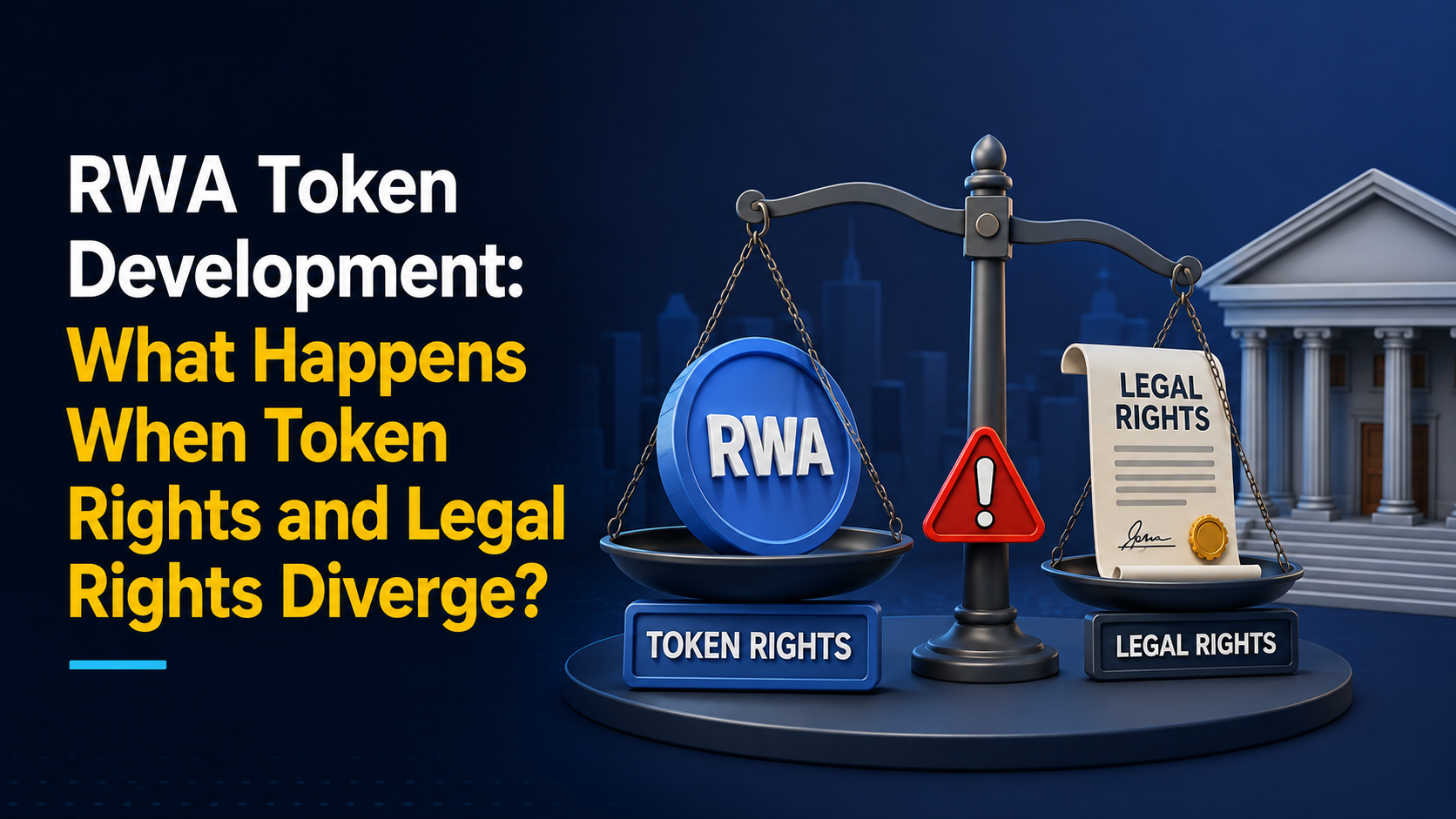
RWA token development connects blockchain-based tokens with assets that exist in the physical or traditional financial world. These assets can include real estate, private credit, commodities, artwork, funds, invoices, or other financial interests. A token may represent ownership, a claim on income, a debt interest, or another contractual right connected to an asset. However, the existence of a blockchain token does not automatically mean that the holder has the same rights recognized under applicable law.
This distinction becomes important when token rights and legal rights do not match. A token holder may believe that holding a certain number of tokens gives them ownership of an asset, while the legal documents may provide a different arrangement. In another situation, a smart contract may transfer tokens automatically, while the underlying legal agreement requires additional procedures before ownership can change.
For businesses working with RWA Tokenization, this gap can create disputes involving ownership, voting rights, income distribution, redemption, transfers, and investor protection. Understanding where token rights come from and how they connect with legal agreements is therefore an important part of planning an RWA token development project.
Understanding Token Rights and Legal Rights
Token rights are the rights represented through a blockchain token and its associated smart contract. Depending on the project, a token may provide access to income, voting, redemption, governance, repayment, or ownership-related benefits. These rights are generally described through token documentation, smart contract rules, offering documents, and contractual terms.
Legal rights come from laws, regulations, contracts, company records, property registries, security agreements, and other recognized legal instruments. For example, owning a token that represents an interest in a property does not necessarily make the holder the registered owner of that property. The actual legal ownership may remain with a company or special purpose vehicle that holds the property.
This difference means that token ownership and legal ownership should not be treated as identical concepts. An RWA tokenization project needs a legal structure that explains exactly what the token represents and how that representation is recognized under the relevant jurisdiction.
How Can Token and Legal Rights Diverge?
Rights can diverge for several reasons. One common situation occurs when the blockchain records a token transfer, but the legal ownership record is maintained somewhere else. If the legal registry is not updated, the blockchain transaction may show a new token holder while the legally recognized ownership remains unchanged.
Another situation occurs when a smart contract contains rules that are different from the underlying legal agreement. For example, the smart contract may permit a token transfer at any time, while the legal agreement may restrict transfers to approved investors. If the two systems do not follow the same rules, the parties can face conflicting claims.
Differences can also occur when regulations change after tokens have been issued. A token may initially be structured under one legal interpretation, but a later regulatory decision may affect how that token is treated. The project then needs to assess whether the existing token rights still correspond with the applicable legal rights.
The Role of Legal Agreements in RWA Token Development
Legal agreements provide the foundation for determining what a token actually represents. They can specify the relationship between token holders, asset owners, issuers, custodians, administrators, and other parties involved in the project.
For example, a real estate token may represent shares in a legal entity that owns a property rather than direct ownership of the property itself. In this case, the token holder's rights may include receiving a portion of rental income or participating in certain decisions concerning the entity.
The smart contract should reflect these contractual arrangements as closely as practical. If the legal agreement says that only verified investors can hold the tokens, the token transfer system should have a method for enforcing that requirement. If token holders have voting rights under specific conditions, those conditions should also be represented consistently across the relevant systems.
This legal and technical connection is one of the areas where RWA Tokenization Services can help businesses structure their projects before token issuance.
What Happens When a Token Holder Claims Ownership?
Suppose an investor purchases 5% of the tokens connected with a commercial property. The investor assumes that this means they directly own 5% of the building. However, the legal documents state that the property is owned by a special purpose company and that the tokens represent shares in that company.
In this situation, the investor does not necessarily have direct property ownership. Their legal rights depend on the corporate structure, shareholder agreement, token terms, and applicable property laws.
This distinction can affect several matters. The investor may have a right to receive income generated by the property, but may not have the right to sell the property. They may have voting rights in the company, but those rights could be limited by the shareholder agreement. They may also have rights concerning distributions without having direct authority over property management.
Therefore, RWA token development should begin with a precise definition of what each token represents rather than simply creating a digital representation of an asset.
The Importance of Matching Smart Contracts With Legal Terms
Smart contracts control many token-related actions, including transfers, minting, burning, distributions, voting, and restrictions. Once deployed, these rules can operate automatically according to their programming.
Legal contracts work differently. They establish obligations between people and organizations under a particular legal system. A legal agreement may contain provisions that cannot be represented fully through smart contract code.
For this reason, a project should not assume that smart contract logic alone determines the complete set of investor rights. The legal documents and technical system need to work together.
A practical structure may include an issuer agreement, investor agreement, asset ownership arrangement, token terms, compliance policies, and smart contract rules. Each document should use consistent definitions for the token, underlying asset, investor rights, transfer conditions, income rights, and dispute procedures.
Regulatory Issues When Rights Do Not Match
The legal treatment of tokenized assets depends heavily on the jurisdiction and the nature of the underlying asset. Some tokens may be treated as securities, while others may fall under different financial or property-related frameworks.
If a project markets tokens as ownership interests while its legal documents provide only contractual claims, regulators or investors may question the accuracy of those representations. Similar concerns can arise when a token is presented as freely transferable even though the legal framework places restrictions on who can hold it.
A project using Real World Asset Tokenization should therefore examine securities laws, property regulations, corporate law, taxation, anti-money laundering requirements, investor eligibility rules, and transfer restrictions where applicable.
Legal review should take place before token issuance and should continue when the project's structure, asset type, investor base, or operating jurisdiction changes.
How RWA Platforms Can Handle Conflicting Rights
An RWA platform can use several technical methods to reduce the chance of conflict between blockchain records and legal records.
One method is permissioned token transfers. Instead of allowing every wallet to receive a token, the platform can verify whether a participant meets the required conditions before allowing a transfer.
Another method is investor identity mapping. The platform can associate verified investor records with blockchain wallet addresses. This creates a connection between the digital token holder and the legally identified participant.
A third method involves administrative controls. Certain actions, such as freezing transfers, correcting records after a legal decision, or handling disputed transactions, may require authorized administrative procedures.
The platform can also maintain records outside the blockchain for documents that cannot or should not be stored directly on-chain. These may include agreements, investor records, valuation reports, ownership documents, and compliance information.
These functions are commonly considered during RWA tokenization platform development because the platform needs to handle more than token transfers alone.
What If the Blockchain Record Is Wrong?
Blockchain records are generally designed to provide a persistent transaction history. However, a blockchain record does not automatically make an incorrect transaction legally valid.
Imagine that a token is transferred to an investor who was not legally permitted to acquire it. The blockchain may permanently show that transfer. The legal framework may nevertheless require the transfer to be reversed, restricted, or otherwise addressed.
This creates a practical challenge for tokenized asset platforms. A system may need procedures for handling mistaken transfers, court orders, fraudulent activity, regulatory restrictions, or other situations where the blockchain record and legal position differ.
Depending on the project's legal structure, this may involve freezing the token, restricting future transfers, issuing replacement tokens, recording an administrative adjustment, or following another legally approved process.
The exact approach depends on the token model and jurisdiction. It should be decided before launch rather than after a dispute occurs.
Custody and Asset Ownership Considerations
The relationship between token holders and the entity holding the underlying asset also matters. In many RWA models, the physical or financial asset is held by a legal entity, custodian, trustee, or special purpose vehicle.
The token may then represent a claim connected with that structure. If the custodian becomes insolvent, loses control of the asset, or fails to follow the contractual arrangement, token holders may face legal questions that cannot be resolved through blockchain code alone.
This is why custody arrangements should be documented carefully. Investors need to understand who owns the asset, who controls it, what rights token holders have, and what happens if the issuer or custodian experiences financial or operational problems.
For an RWA Tokenization Company, these matters can influence the entire architecture of the tokenization project.
Investor Protection When Rights Diverge
Investor communication becomes especially important when token rights do not represent direct legal ownership. Project operators should describe the token's rights accurately in offering materials and agreements.
Investors should be able to understand whether they are purchasing direct ownership, shares in an entity, debt claims, revenue rights, fund interests, or another type of contractual interest.
The platform should also explain restrictions on transfers, redemption conditions, income distributions, voting rights, and events that could affect the value or enforceability of the token.
Good documentation cannot remove every legal risk, but it can reduce misunderstandings between issuers and investors. It also gives technical teams a more precise basis for implementing token functions.
Handling Disputes Between Token Holders and Issuers
A dispute may arise when a token holder believes the blockchain gives them a certain right while the issuer relies on a legal agreement that says otherwise.
The project should have a predefined dispute process. This can include identifying the controlling legal agreement, verifying the investor's identity, reviewing transaction records, checking the applicable law, and determining whether the token transaction complied with the project's rules.
Some projects may also include arbitration or court jurisdiction clauses in their legal agreements. These provisions can help determine how disputes are handled.
The smart contract itself should not be considered a complete dispute resolution mechanism. Code can execute predefined actions, but legal disputes often involve facts, contracts, regulatory obligations, and circumstances that require human or institutional review.
Designing RWA Tokenization Around Legal Reality
The safest approach is to define the legal rights before finalizing the token mechanics. The asset should first be placed within an appropriate legal structure. The project team can then determine what investors receive and how those rights should appear through the token.
The next stage is to map those rights to technical functions. If investors receive income, the platform needs a distribution mechanism. If transfers are restricted, the token system needs appropriate controls. If voting is provided, the governance logic should follow the legal voting framework.
This approach allows the technical architecture to reflect the actual investment arrangement instead of treating the token as a separate product.
For businesses working with an RWA tokenization development company, this mapping process should involve legal specialists, blockchain developers, compliance professionals, asset owners, and financial advisers where appropriate.
Role of RWA Tokenization Development Services
RWA tokenization development services can cover the technical systems required to issue, manage, transfer, and monitor asset-backed tokens. Depending on the project, these services may include smart contract development, token standards, investor onboarding, wallet management, compliance controls, asset dashboards, payment processing, distribution mechanisms, and administrative tools.
However, technical development alone does not determine legal ownership. The development team needs to receive the project's legal requirements and convert them into suitable platform functions.
This is particularly important for Real World Asset Tokenization Services because different assets require different legal and technical structures. A token representing real estate may operate differently from one representing private credit, commodities, or investment fund interests.
Why Legal Alignment Matters Before Launch
Correcting a rights mismatch after tokens have been sold can be difficult. Investors may already hold tokens across different wallets, secondary transactions may have occurred, and income distributions may already have been processed.
A project can reduce these problems by reviewing the relationship between legal documents and token functions before launch. Legal terms should be checked against smart contract behavior, platform workflows, investor disclosures, and transfer rules.
Testing should also include unusual situations. What happens when an investor loses access to a wallet? What happens if a transfer is made to an ineligible participant? What happens when an asset is sold? What happens if the issuer becomes insolvent?
Answering these questions early gives the project a better basis for managing rights throughout the asset's lifecycle.
Conclusion
RWA Token Development is not simply the process of putting an asset on a blockchain. It involves connecting digital tokens with legal structures that determine what investors actually own or have a right to claim. When token rights and legal rights diverge, disputes can arise around ownership, income, voting, transfers, redemption, and regulatory treatment. A well-planned project therefore needs legal agreements, asset ownership structures, compliance procedures, and smart contract rules that work together. RWA Tokenization, RWA Tokenization Company models, RWA Tokenization Services, Real World Asset Tokenization, and Real World Asset Tokenization Services all require careful attention to the relationship between digital records and legally recognized rights. By defining investor rights before development and mapping those rights into the platform, businesses can reduce confusion and create a more consistent tokenization model. Blockchain App Factory provides RWA tokenization development services that help businesses plan and develop blockchain-based systems for tokenized real-world assets while addressing the technical requirements of their chosen tokenization model.
FAQs
1. What happens when token rights and legal rights differ?
When token rights and legal rights differ, the investor may not receive the rights they assume from holding the token. The applicable legal agreements and regulations determine the legally recognized position, subject to the specific structure and jurisdiction.
2. Does owning an RWA token mean owning the underlying asset?
Not always. An RWA token may represent direct ownership, an interest in a legal entity, a debt claim, revenue rights, or another contractual interest. The project's legal documents should explain what the token represents.
3. Can smart contracts override legal agreements?
A smart contract can execute programmed actions, but its code does not automatically replace applicable law or contractual obligations. The legal and technical structures should be designed to work consistently.
4. How can RWA platforms reduce rights conflicts?
Platforms can use permissioned transfers, investor verification, wallet identity mapping, administrative controls, compliance checks, and procedures for handling disputed or restricted transactions.
5. Why are legal agreements important in RWA tokenization?
Legal agreements define the rights and obligations associated with the token and underlying asset. They help establish what investors can claim and how those claims are handled under applicable law.
6. What is the role of an RWA tokenization development company?
An RWA tokenization development company can develop the technical infrastructure for token issuance, smart contracts, investor onboarding, asset management, compliance workflows, transfers, and other platform functions based on the project's legal and business requirements.
7. Can an incorrect blockchain transaction be legally reversed?
A blockchain transaction may remain recorded on-chain even when a legal process requires corrective action. Depending on the project's design, controls may allow tokens to be frozen, restricted, replaced, or otherwise handled through an approved procedure.
8. What should businesses decide before starting RWA token development?
Businesses should first define the underlying asset, ownership structure, investor rights, applicable regulations, transfer restrictions, income arrangements, custody model, dispute procedures, and token functions. These decisions provide the basis for the technical development process.
9. Is RWA tokenization suitable for every real-world asset?
No. The suitability depends on the asset, legal structure, jurisdiction, investor requirements, liquidity expectations, compliance obligations, and business model. Each asset category needs its own legal and technical assessment.
10. How does RWA tokenization platform development support legal compliance?
The platform can include identity verification, investor eligibility checks, transfer restrictions, transaction records, administrative controls, and reporting functions. These features can support compliance requirements when designed according to the project's applicable legal framework.

 English
 Arabic
 French
 Spanish
 Portuguese
 Deutsch
 Turkish
 Dutch
Dutch
 Italiano
 Russian
 Romaian
 Portuguese (Brazil)