Introduction
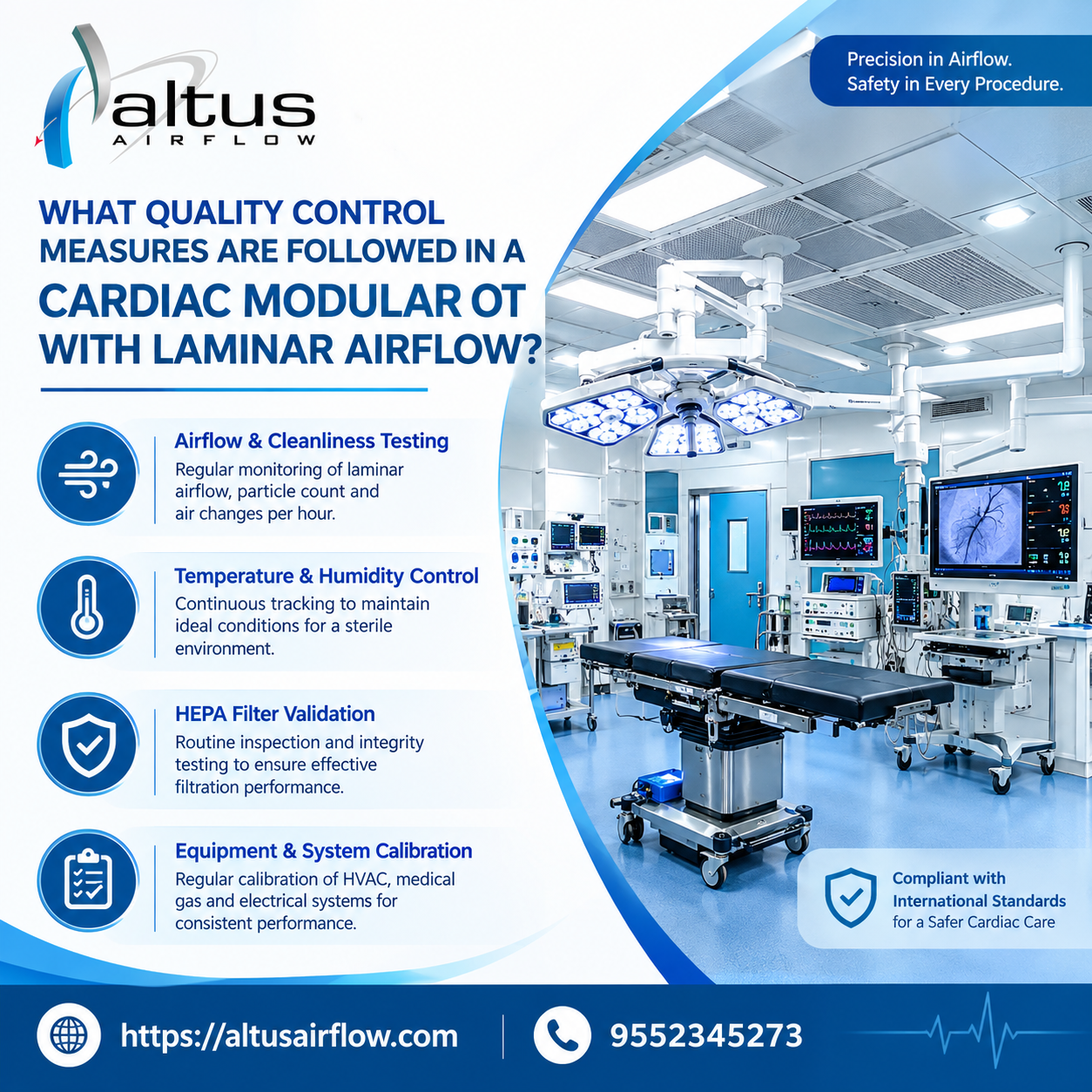
Altus Airflow focuses on coordinated engineering and controlled-environment solutions for specialized hospital facilities. A Cardiac Modular OT With Laminar Airflow requires careful quality control because several critical systems must work together within a controlled surgical environment. Modular wall and ceiling systems, HVAC equipment, filtration units, electrical services, medical gases, surgical lighting, monitoring systems, and airflow arrangements all need to meet their specified requirements. Quality control therefore begins during design and continues through material selection, installation, inspection, testing, commissioning, and final handover.
A structured quality process helps identify installation problems before the operating theatre becomes operational. It can include checking construction materials, verifying dimensions, inspecting joints and finishes, testing airflow performance, examining filtration systems, monitoring temperature and humidity, checking pressure relationships, and validating supporting utilities. Documentation is also important because test results and inspection records provide evidence that installed systems have been checked. Through systematic quality control, hospitals can develop a more reliable, organized, and maintainable cardiac surgical environment while supporting the operational requirements of medical teams.
1. Design Review and Planning
Quality control starts before construction begins. The OT design is reviewed to ensure that room dimensions, workflow, HVAC requirements, filtration, electrical services, medical gases, equipment locations, and maintenance access are properly coordinated.
Design reviews can identify potential conflicts between different systems before materials are procured or installed. This early-stage verification helps establish clear technical requirements for the project.
2. Verification of Modular Materials
Modular panels, ceilings, doors, flooring, and other components are inspected before installation. Material specifications should correspond with the approved project requirements.
Panels should be checked for dimensional accuracy, surface quality, structural condition, and compatibility with the intended OT environment. Damaged or unsuitable materials should be identified before installation.
3. Inspection of Wall and Ceiling Installation
The modular walls and ceiling form an important part of the controlled environment. Quality checks can verify panel alignment, joints, sealing, connections, and finishing.
Particular attention should be given to areas around service penetrations, doors, windows, electrical outlets, and medical gas connections. Proper sealing helps maintain the intended room enclosure.
4. Surface Finish Inspection
OT surfaces should be smooth, durable, and suitable for routine cleaning. Quality control can include checking walls, ceilings, flooring, doors, and other exposed surfaces.
Inspectors can look for gaps, cracks, uneven joints, damaged finishes, or other conditions that could interfere with cleaning and maintenance.
5. HVAC Installation Checks
The HVAC system is one of the most important technical systems in the OT. Quality control includes verifying that air-handling units, ductwork, dampers, filters, diffusers, controls, and associated components have been installed according to the approved design.
Installation inspections should also consider accessibility for maintenance and replacement of filters or other service components.
6. Airflow Measurement
Airflow measurements help verify whether the ventilation system is delivering the required volume of air. Measurements can be taken at supply and return points using appropriate instruments.
The recorded values can then be compared with the project specifications. If readings differ significantly from the expected values, corrective adjustments may be required before commissioning is completed.
7. Laminar Airflow Performance Testing
Laminar airflow systems require specific performance checks. Testing may assess airflow velocity, uniformity, direction, and distribution across the designated surgical zone.
The objective is to confirm that the installed system produces the intended controlled airflow pattern. Testing should be performed using calibrated instruments and documented results.
8. HEPA Filter Integrity Testing
HEPA filters are important components of controlled-air environments. Integrity testing can help identify leaks, damaged filter media, or sealing problems.
A suitable testing procedure can verify the condition of the filter installation and housing. Any leakage detected during testing should be investigated and corrected before final acceptance.
9. Differential Pressure Verification
Pressure relationships between the OT and adjacent areas can be checked during commissioning. Appropriate pressure differentials help maintain the intended airflow direction between spaces.
Pressure readings should be recorded under defined operating conditions. Control settings can be adjusted when readings do not match the specified design requirements.
10. Temperature and Humidity Monitoring
Temperature and relative humidity can affect the operating environment and comfort of clinical staff. Quality control therefore includes checking whether environmental conditions remain within the specified operating range.
Sensors, controllers, and monitoring devices should also be checked for proper operation and appropriate calibration.
11. Airflow Direction Verification
Airflow should move in the intended direction between controlled areas. Verification can be performed using suitable visualization or measurement methods.
This check helps identify unexpected air movement caused by incorrect pressure relationships, leakage, door movement, or HVAC balancing issues.
12. Air Changes and Ventilation Verification
The ventilation system should be assessed to determine whether the required air exchange is being achieved. Airflow readings and room volume calculations can be used to verify the ventilation performance.
These checks should form part of the overall HVAC commissioning process rather than being considered separately from filtration and pressure testing.
13. Electrical System Inspection
Electrical systems require systematic inspection before the OT becomes operational. Checks may include distribution boards, dedicated circuits, sockets, grounding, protective devices, control panels, and emergency power connections.
Electrical testing should be performed by qualified personnel using appropriate procedures and instruments.
14. Emergency Power Verification
Cardiac surgical environments require dependable power arrangements for critical systems and equipment. Quality control can verify connections to backup power systems and confirm that designated loads receive power when required.
Testing may include transfer arrangements, essential circuits, alarms, and related electrical controls.
15. Medical Gas System Testing
Medical gas pipelines and outlets should be inspected and tested according to applicable project requirements. Quality checks can cover pipeline installation, identification, connections, pressure testing, outlet positioning, and leak detection.
Documentation of testing provides an important record for hospital engineering and maintenance teams.
16. Surgical Lighting Inspection
Surgical lighting needs to be correctly installed and positioned according to the operating room layout. Quality control can verify mounting arrangements, movement, illumination, controls, and electrical connections.
The relationship between surgical lights and airflow components should also be checked where laminar airflow is part of the design.
17. Medical Pendant Verification
Medical pendants can carry electrical outlets, medical gas terminals, data connections, and other services. Their location and movement should be checked against the approved equipment layout.
Quality inspections can verify structural mounting, utility connections, positioning, and operational movement before handover.
18. Environmental Monitoring System Checks
Modern OTs may use digital systems to monitor temperature, humidity, pressure, alarms, and other environmental parameters.
Quality control should verify sensor placement, readings, alarm settings, data logging, and communication with the relevant monitoring platform.
19. Alarm System Testing
Environmental and equipment alarms provide notifications when monitored conditions move outside predefined limits. Quality control can include testing alarm activation, display, notification, and reset functions.
Each alarm should respond appropriately to its designated trigger condition.
20. Cleanability and Hygiene Inspection
The completed OT should be inspected for areas that could make routine cleaning difficult. Joints, corners, penetrations, door interfaces, ceiling connections, and equipment bases should be reviewed.
Smooth and properly sealed surfaces can make routine cleaning and maintenance more manageable.
21. Equipment Interface Checks
Medical equipment often depends on several building services simultaneously. Quality control should therefore verify the relationship between equipment locations and electrical, medical gas, data, HVAC, and structural provisions.
This can help identify service conflicts before equipment installation or clinical use.
22. Calibration of Measuring Instruments
Accurate testing depends on appropriate measurement equipment. Instruments used for airflow, pressure, temperature, humidity, electrical testing, and other parameters should be suitably calibrated.
Calibration records help demonstrate that measurements were taken using instruments operating within their required accuracy.
23. Documentation of Test Results
Every major quality check should be documented. Test reports can include measurement values, equipment identification, testing conditions, instrument details, dates, and responsible personnel.
Well-organized documentation allows hospital teams to review the performance of the installed systems and maintain records for future reference.
24. Corrective Action and Retesting
Quality control does not end when a problem is identified. If testing shows that a system does not meet the specified requirement, corrective action should be taken.
After adjustments or repairs, the affected system should be retested. This confirms whether the corrective work has resolved the identified issue before final commissioning.
25. Final Commissioning and Handover
Final commissioning brings together the results of individual inspections and system tests. HVAC, airflow, filtration, pressure, electrical systems, medical gases, monitoring systems, and other components can be reviewed before handover.
A structured final inspection helps ensure that outstanding issues are addressed and that relevant test reports, drawings, manuals, warranties, and maintenance information are provided to the hospital.
Conclusion
A Cardiac Modular OT With Laminar Airflow requires quality control across construction, HVAC, filtration, airflow, electrical systems, medical gases, monitoring, equipment interfaces, and final commissioning. Measures such as HEPA filter integrity testing, airflow measurement, laminar airflow verification, differential pressure checks, temperature and humidity monitoring, electrical inspection, and medical gas testing help verify that individual systems perform according to their specified requirements.
A systematic approach also makes it easier to document test results, identify deficiencies, complete corrective actions, and conduct final handover. By applying coordinated quality control procedures, Altus Airflow can support hospitals in developing controlled and technically organized cardiac OT environments. With proper testing and maintenance planning, Altus Airflow can contribute to reliable long-term operation and easier management of critical OT infrastructure.
Frequently Asked Questions
1. What quality control measures are used in a Cardiac Modular OT With Laminar Airflow?
A Cardiac Modular OT With Laminar Airflow can undergo modular construction inspections, airflow testing, HEPA filter integrity testing, pressure verification, temperature and humidity checks, electrical testing, medical gas testing, and final commissioning.
2. Why is laminar airflow testing important?
It verifies whether airflow velocity, direction, uniformity, and distribution meet the specified design requirements.
3. Are HEPA filters tested before OT handover?
Yes. HEPA filter integrity testing can be performed to identify leaks or installation problems before commissioning.
4. Is differential pressure checked?
Yes. Pressure relationships between the OT and adjacent areas can be measured and documented during commissioning.
5. Are electrical and medical gas systems tested?
Yes. Electrical installations, backup power connections, medical gas pipelines, outlets, and related systems can be inspected and tested according to project requirements.
Read Our Previous Blog --------------->What are the advantages of a turnkey Cardiac Modular Operation Theatre?

 Arabic
 French
 Spanish
 Portuguese
 Deutsch
 Turkish
 Dutch
Dutch
 Italiano
 Russian
 Romaian
 Portuguese (Brazil)
 Greek
Greek