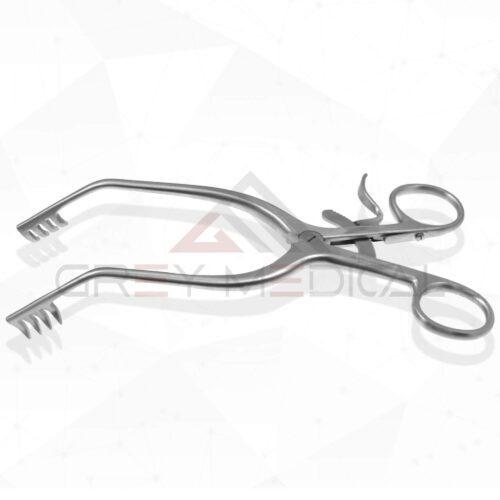
A self-retaining retractor is a surgical instrument designed to hold tissues and organs away from the operative field without requiring continuous manual assistance. Its locking mechanism allows surgeons to maintain consistent tissue retraction during procedures. This self-retaining retractor can improve visibility and provide greater access to the surgical site. GreyMedical®️ is a privately owned medical technology company dedicated to innovation and excellence in the craft of surgical instruments.

Design and Working Principle
The design of a self-retaining retractor allows the instrument to remain securely positioned after the desired level of retraction has been established. Many models include adjustable blades, rings, or locking mechanisms that help maintain controlled tension. Surgeons can adjust the instrument according to the surgical site and the amount of exposure required. The stable design can also help reduce the need for an assistant to hold the retractor throughout the procedure.
Common Surgical Applications
A self-retaining retractor can support tissue exposure across several surgical specialties. Surgeons may use these surgery instruments in general, abdominal, orthopedic, gynecological, and thoracic procedures, depending on the instrument's design. Their ability to maintain retraction can provide a clearer working area and help surgeons access deeper anatomical structures. Different sizes and blade configurations make these retractors suitable for a variety of operative requirements.
Key Features for Surgical Performance
A well-designed self-retaining retractor combines stability, adjustability, and ease of handling. Its locking system should provide reliable positioning while allowing surgeons to make controlled adjustments during surgery. Smooth surfaces and carefully finished edges can support gentle tissue handling and help reduce unnecessary trauma. High-quality surgical-grade materials also contribute to durability, corrosion resistance, and reliable performance during repeated sterilization.
Choosing the Right Retractor
Selecting a self-retaining retractor requires consideration of the procedure, surgical site, required depth, and preferred blade configuration. The appropriate size should provide sufficient exposure without applying unnecessary pressure to surrounding tissues. Surgeons and healthcare facilities should also consider instrument ergonomics, material quality, sterilization compatibility, and overall construction. Choosing the correct design can support efficient surgical handling and consistent operative exposure.
Conclusion
Self-retaining retractors play an important role in modern surgery by maintaining tissue retraction while allowing the surgical team to focus on other critical tasks. Their adjustable designs and secure locking mechanisms make them useful across various procedures. By selecting instruments with suitable dimensions, reliable construction, and appropriate blade configurations, healthcare professionals can support effective surgical exposure and controlled tissue management. GreyMedical®️ focuses on innovation and excellence to provide surgical instruments designed to meet the demanding requirements of modern medical practice.

 Arabic
 French
 Spanish
 Portuguese
 Deutsch
 Turkish
 Dutch
Dutch
 Italiano
 Russian
 Romaian
 Portuguese (Brazil)
 Greek
Greek