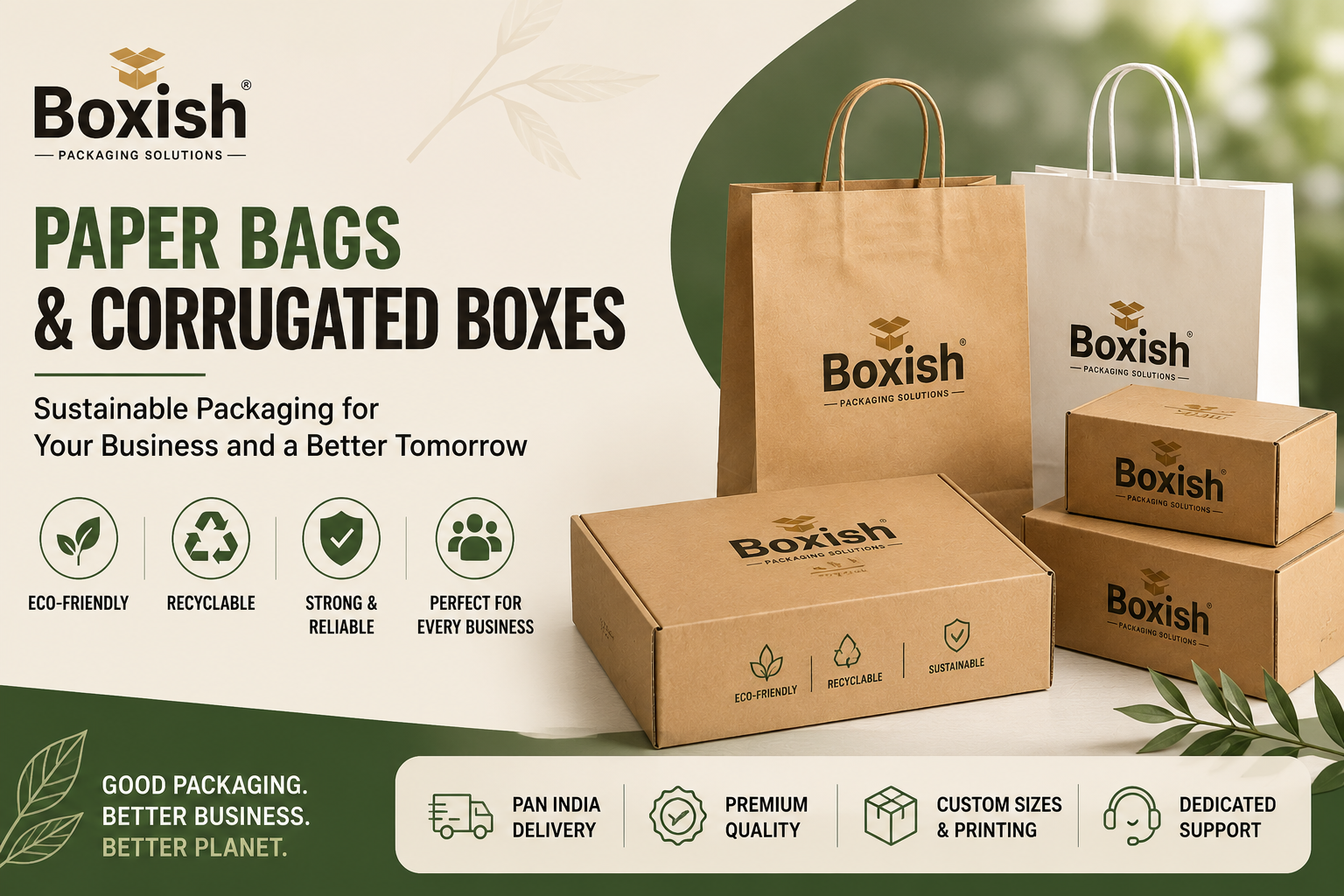
Businesses across ecommerce, retail, food, manufacturing, and distribution depend on reliable packaging to protect products during storage, handling, and transportation. Among the many packaging options available, corrugated boxes are one of the most practical choices because they offer a good balance of strength, weight, flexibility, and cost.
However, not every box is designed for the same purpose. A small product may require a lightweight box, while heavier or fragile products may need stronger construction. Understanding the different types of corrugated boxes can help businesses select packaging that matches their products, shipping requirements, and budget.
What Is a Corrugated Box?
A corrugated box is a packaging container made from corrugated board. The board generally consists of a fluted paper layer placed between one or more flat liner sheets. The fluted layer creates cushioning and adds structural strength.
The most common construction is a 3-ply box, which has one fluted layer between two liner sheets. For heavier applications, 5-ply construction provides additional strength and resistance to compression.
Corrugated boxes are widely used for shipping, storage, product packaging, and distribution because they can be manufactured in different sizes and specifications.
Why Are Corrugated Boxes Important for Businesses?
Choosing suitable packaging can affect product safety, transportation efficiency, storage, and customer experience. Corrugated boxes offer several practical advantages:
-
Product protection: The fluted structure helps absorb impacts and reduces the risk of damage.
-
Lightweight construction: Boxes provide useful strength without adding excessive shipping weight.
-
Size flexibility: Businesses can choose standard or customized dimensions.
-
Easy storage: Flat-packed boxes occupy less warehouse space before use.
-
Stackability: Properly designed boxes can be stacked efficiently during storage and transportation.
-
Custom printing: Businesses can add logos, product information, handling instructions, or other branding elements.
-
Cost efficiency: Corrugated packaging can be suitable for both small businesses and high-volume operations.
Different Types of Corrugated Boxes
Corrugated boxes can be categorized according to their construction, design, strength, and intended application. Here are some of the most commonly used types.
1. 3-Ply Corrugated Boxes
3-ply boxes are made with two liner sheets and one fluted layer between them. They are lightweight and suitable for products that do not require extremely high compression strength.
Common applications include:
-
Small ecommerce products
-
Clothing
-
Books
-
Stationery
-
Household products
-
Lightweight retail goods
For businesses shipping lightweight products, 3-ply boxes can provide a practical balance between protection and packaging cost.
2. 5-Ply Corrugated Boxes
5-ply boxes contain additional layers of paper and fluting compared with 3-ply construction. This makes them stronger and more suitable for heavier products or longer-distance transportation.
They are commonly used for:
-
Industrial products
-
Heavy retail goods
-
Machinery components
-
Bulk shipments
-
Fragile products requiring additional protection
-
Warehouse transportation
Businesses should consider 5-ply construction when packaging will experience higher stacking pressure, heavier loads, or demanding transportation conditions.
3. Single-Wall Corrugated Boxes
Single-wall corrugated boxes generally contain one fluted layer between two liner sheets. They are widely used because they are relatively lightweight and easy to handle.
They work well for everyday shipping and storage applications where moderate protection is required.
4. Double-Wall Corrugated Boxes
Double-wall boxes contain two fluted layers with additional liner material. Their stronger construction makes them suitable for heavier or more fragile products.
They can be useful when packages need to withstand greater compression, stacking, and handling during transportation.
5. Regular Slotted Cartons
Regular slotted cartons, often called RSC boxes, are among the most commonly used corrugated box designs. Their flaps meet at the center when the box is closed.
They are widely used for:
-
Ecommerce shipping
-
Warehousing
-
Retail distribution
-
General product transportation
-
Industrial packaging
Their simple design also makes them efficient for large-scale packing operations.
6. Die-Cut Corrugated Boxes
Die-cut boxes are manufactured using a cutting and creasing process that allows manufacturers to create specific shapes and folding patterns.
They can be useful for products that require a more precise fit or a specialized presentation.
Applications include:
-
Electronics
-
Gift products
-
Retail packaging
-
Small consumer products
-
Promotional packaging
Die-cut designs can also reduce the need for additional packaging materials when the box is designed to hold the product securely.
7. Ecommerce Shipping Boxes
Ecommerce businesses need packaging that can handle multiple stages of transportation, including warehouse handling, courier movement, sorting, and final delivery.
Ecommerce shipping boxes are designed around these requirements and are available in different sizes and strengths.
The right box should provide enough internal space for the product and protective material without leaving excessive empty space.
8. Corrugated Mailer Boxes
Mailer-style corrugated boxes are designed to fold and close without requiring extensive assembly. They can provide a neat presentation while protecting products during delivery.
They are often suitable for:
-
Subscription products
-
Clothing
-
Beauty products
-
Small electronics
-
Gifts
-
Direct-to-consumer products
Their convenient opening and closing design can also improve the unboxing experience.
9. Printed Corrugated Boxes
Printed corrugated boxes allow businesses to add branding and important product information directly to the packaging.
Businesses can use printing for:
-
Brand logos
-
Product names
-
Handling instructions
-
Fragile warnings
-
Contact information
-
Promotional messages
For ecommerce businesses, printed packaging can turn an ordinary shipping package into part of the customer experience.
Choosing the Right Corrugated Box for Your Business
Selecting packaging should not be based on box size alone. Businesses should consider several factors before placing an order.
Consider Product Weight
The weight of the product is one of the first factors to evaluate. Lightweight products may work well with 3-ply boxes, while heavier products may require stronger construction.
Check Product Dimensions
Measure the product's length, width, and height before selecting a box. The box should provide enough room for the product and any protective material without creating unnecessary empty space.
Consider Fragility
Fragile products may require stronger corrugated construction along with internal protection such as paper cushioning, inserts, or other protective materials.
Evaluate Shipping Conditions
If products travel long distances or pass through multiple handling stages, packaging may need higher strength and better resistance to compression.
Think About Storage
Businesses should also consider how many boxes they need to store before use. Flat-packed corrugated boxes are generally convenient because they can be stored efficiently.
Consider Customization
If packaging is an important part of your brand identity, consider customized dimensions, printing, or structural designs.
Corrugated Boxes for Ecommerce Businesses
Ecommerce packaging has to perform several jobs at once. It must protect the product, remain practical for warehouse teams, survive transportation, and provide a reasonable customer experience.
The ideal box should fit the product closely while leaving enough space for protective material. Oversized packaging can increase material usage and transportation costs, while undersized packaging may increase the risk of product damage.
Businesses should also consider how the package will be handled by courier companies. Strong corners, suitable board construction, and proper sealing can help improve package durability.
Using Paper Bags Alongside Corrugated Packaging
Corrugated boxes are not the only packaging format businesses may need. Retail businesses often use a paper bag when customers purchase products in-store or need a convenient way to carry lightweight goods.
For example, a clothing retailer may use corrugated boxes for bulk transportation and paper bags for customers at the point of sale. Using different packaging formats for different stages can create a more efficient overall packaging system.
Paper bags can be particularly useful for:
-
Clothing stores
-
Gift shops
-
Bakeries
-
Retail stores
-
Boutiques
-
Promotional events
The key is to select packaging according to the product and situation rather than relying on one packaging format for every requirement.
Pizza Boxes for Food Businesses
Restaurants, pizzerias, bakeries, and cloud kitchens have different packaging requirements from ecommerce businesses. Products need packaging that supports safe handling and convenient delivery.
Pizza boxes are specifically designed for pizza transportation and presentation. Their shape provides enough space for the pizza while allowing the package to be stacked and handled conveniently.
When selecting pizza packaging, food businesses should consider:
-
Pizza size
-
Box strength
-
Ventilation requirements
-
Stacking
-
Storage space
-
Printing and branding
-
Delivery distance
A properly selected pizza box can help maintain the presentation of the food while making delivery easier for staff and customers.
How Corrugated Boxes Can Improve Warehouse Operations
Packaging also affects internal business operations. Standardized box sizes can make packing stations easier to organize and help employees work more efficiently.
Businesses can create a packaging system based on product categories. For example:
-
Small boxes for accessories
-
Medium boxes for standard ecommerce orders
-
Large boxes for bulk products
-
Stronger boxes for heavy products
-
Specialized boxes for fragile items
Keeping commonly used box sizes organized can reduce packing delays and make inventory management easier.
Common Mistakes Businesses Should Avoid
Even good-quality packaging can become ineffective if it is selected or used incorrectly.
Using the Wrong Box Size
A box that is too large can leave excessive empty space, while a box that is too small can put pressure on the product.
Ignoring Product Weight
Using lightweight packaging for heavy products can increase the risk of box failure during transportation.
Choosing Strength Based Only on Price
The cheapest box is not always the most economical option. Product damage, returns, and replacements can cost much more than choosing suitable packaging initially.
Poor Sealing
Even a strong box can open during transportation if it is not sealed properly. Businesses should select suitable sealing methods according to package weight and shipping conditions.
Buying Too Many Different Sizes
Maintaining an excessive number of box sizes can make inventory management complicated. Businesses should identify their most common product dimensions and build a practical packaging range.
Tips for Buying Corrugated Boxes in Bulk
Businesses purchasing packaging in larger quantities should evaluate more than the per-box price.
Consider:
-
Board construction and ply.
-
Box dimensions.
-
Product weight capacity.
-
Printing requirements.
-
Minimum order quantity.
-
Storage requirements.
-
Delivery coverage.
-
Quality consistency.
-
Customization options.
-
Supplier reliability.
For growing businesses, establishing standard packaging specifications can also make future procurement easier.
Final Thoughts
Corrugated boxes are available in many constructions and designs, making them suitable for a wide range of business applications. From lightweight 3-ply boxes to stronger 5-ply and double-wall options, businesses can select packaging based on product weight, dimensions, fragility, transportation conditions, and storage requirements.
The best packaging strategy is not necessarily about choosing the strongest box. It is about choosing the right box for the right product and application. Businesses can also combine different packaging formats, such as paper bags for retail purchases and pizza boxes for food delivery, to create a more practical packaging system.
By understanding the available types and evaluating packaging requirements carefully, businesses can improve product protection, packing efficiency, storage, and the overall customer experience.
Frequently Asked Questions
1. What is the most common type of corrugated box?
Regular slotted cartons are among the most commonly used corrugated box designs because they are simple, versatile, and suitable for shipping and storage.
2. Is a 3-ply box suitable for ecommerce shipping?
Yes. A 3-ply box can be suitable for many lightweight ecommerce products. However, the correct choice depends on product weight, dimensions, fragility, and shipping conditions.
3. When should a business use a 5-ply box?
A 5-ply box is generally more suitable for heavier products, fragile goods, bulk shipments, and applications requiring greater compression strength.
4. Can corrugated boxes be customized?
Yes. Corrugated boxes can be customized in terms of dimensions, construction, printing, and structural design depending on the packaging requirement.
5. Why is box size important for shipping?
The correct box size helps reduce unnecessary empty space, improve product protection, and make packing and transportation more efficient.
6. Can businesses use different packaging types together?
Yes. Businesses can use corrugated boxes for shipping, paper bags for retail purchases, and specialized food packaging such as pizza boxes for restaurant delivery. Using each format for its intended purpose can create a more efficient packaging strategy.
If you want, I can also make this more SEO-focused with internal-linking opportunities and 5–7 target keywords, while keeping the keywords naturally distributed.

 Arabic
 French
 Spanish
 Portuguese
 Deutsch
 Turkish
 Dutch
Dutch
 Italiano
 Russian
 Romaian
 Portuguese (Brazil)
 Greek
Greek