The question of intelligence often leads people to compare extraordinary minds with the general population. One of the most common comparisons is between Einstein and the average person, especially when discussing Einstein's IQ. People want to understand how much smarter he was, whether his intelligence can be measured, and what the difference really means in practical terms.
While it is tempting to assign a simple number and compare scores, intelligence is more complex than a single measurement. To truly understand the difference between Einstein and the average IQ range, it is important to explore what IQ tests measure, what is known about Einstein’s intelligence, and how these comparisons should be interpreted.
This article breaks down Einstein’s estimated IQ, explains the average IQ, and highlights the deeper meaning behind intelligence differences.
What Is Einstein's IQ?
The question of Einstein's IQ is one of the most searched topics in discussions about intelligence.
Albert Einstein never took a verified modern IQ test. Because of this, there is no official record of his IQ score.
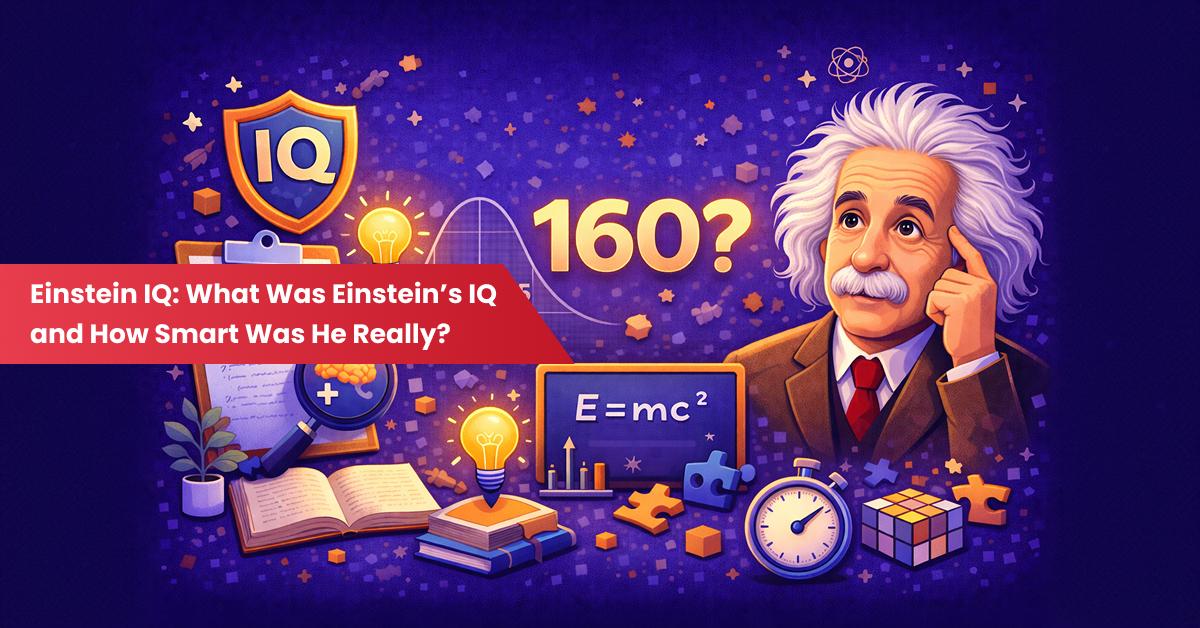
However, many historians and psychologists estimate that Einstein’s IQ would likely fall around 160 if measured by today’s standards. Some estimates vary between 150 and 190, but these numbers are speculative.
These estimates are based on his intellectual achievements, which include:
- Development of the theory of relativity
- Explanation of the photoelectric effect
- Contribution to quantum theory
- Fundamental advances in modern physics
His work reshaped how scientists understand space, time, energy, and gravity.
Even though these accomplishments are extraordinary, it is important to remember that Einstein's IQ is not a measured fact but a widely accepted estimate.
What Is the Average IQ?
To understand the difference, we must first define what average IQ means.
IQ, or Intelligence Quotient, is a standardized score designed so that the average population has a score of 100.
In most modern IQ tests:
- 90 to 110 is considered average
- 100 is the statistical mean
- Below 70 may indicate cognitive challenges
- Above 130 is considered gifted
This means that most people fall within a relatively narrow range around 100.
The IQ scale is designed so that intelligence follows a bell curve distribution. This means that extreme scores, both low and high, are rare.
Einstein's IQ vs Average IQ: The Numerical Gap
If we compare the commonly estimated Einstein's IQ of around 160 with the average IQ of 100, the difference appears significant.
On paper, this suggests:
- Average IQ: 100
- Einstein’s estimated IQ: 160
This 60-point difference places Einstein in an extremely rare statistical category, often described as profoundly gifted.
However, this comparison is not as straightforward as it seems.
IQ scores are not linear representations of intelligence. A score of 160 is not simply “60 percent smarter” than a score of 100. Instead, it represents performance on specific cognitive tasks compared to population norms.
What IQ Tests Actually Measure
To understand the difference between Einstein and the average IQ, it is important to know what IQ tests measure.
Standard IQ tests evaluate abilities such as:
- Logical reasoning
- Pattern recognition
- Verbal comprehension
- Mathematical thinking
- Spatial reasoning
- Working memory
- Processing speed
These skills are important for academic and analytical tasks.
However, IQ tests do not fully measure:
- Creativity
- Curiosity
- Emotional intelligence
- Imagination
- Practical problem-solving
- Persistence
- Innovation
This distinction is crucial when comparing Einstein to the average person.
Einstein’s Intelligence Beyond IQ
When discussing einstein's iq it is easy to focus only on numbers. However, Einstein’s genius was not limited to traditional cognitive testing abilities.
His intelligence was expressed through:
Creativity and Imagination
Einstein often used thought experiments rather than physical experiments.
He imagined scenarios such as riding alongside a beam of light, which led to major breakthroughs in physics.
This level of abstract thinking goes beyond what standard IQ tests measure.
Deep Curiosity
Einstein constantly questioned how the universe works.
He was not satisfied with simple explanations and always sought deeper understanding.
Independent Thinking
He frequently challenged established scientific ideas.
This ability to think differently allowed him to develop revolutionary theories.
Persistence and Focus
Einstein spent years refining his theories.
His breakthroughs were not instant results but the outcome of long-term intellectual effort.
The Average IQ Profile
The average IQ of 100 represents the general population.
People in this range typically have:
- Functional problem-solving abilities
- Basic to moderate academic performance
- Everyday reasoning skills
- Standard memory and comprehension abilities
It is important to note that average intelligence is fully capable of handling daily life, education, and many professional roles.
However, individuals in this range are less likely to engage in abstract theoretical thinking at the level required for groundbreaking scientific discoveries like those made by Einstein.
The Real Difference Between Einstein and Average Intelligence
The difference between Einstein and the average person is not just numerical. It is qualitative.
Depth of Thinking
Einstein was able to think in highly abstract and theoretical ways, while most people focus on concrete problem-solving.
Pattern Recognition
He could identify deep relationships in physical laws that were not obvious.
Imaginative Capacity
Einstein visualized complex physical phenomena mentally before they were mathematically proven.
Intellectual Curiosity
His drive to understand the universe went far beyond average curiosity levels.
Innovation Ability
He did not just solve problems. He redefined the problems themselves.
Why the IQ Comparison Is Misleading
While comparing Einstein's IQ to average IQ is interesting, it can also be misleading.
There are several reasons for this:
1. Einstein Never Took an IQ Test
His score is an estimate, not an official measurement.
2. IQ Does Not Measure Creativity
Many of Einstein’s greatest strengths are not captured by IQ tests.
3. Intelligence Is Multifaceted
Human intelligence includes many different abilities beyond cognitive reasoning.
4. Environment Matters
Access to education, opportunity, and historical context also influence achievement.
Einstein vs Average Person in Real-World Context
Rather than focusing on numbers, it is more meaningful to compare outcomes and abilities.
Einstein:
- Developed theories that changed physics
- Introduced concepts used in modern technology
- Influenced entire fields of science
Average individual:
- Functions effectively in daily life
- Contributes to society in practical and diverse ways
- May excel in non-academic or creative fields
Both types of intelligence are valuable in different contexts.
Can Average Intelligence Achieve Greatness?
One important misconception is that only extremely high IQ individuals can achieve greatness.
While Einstein represents exceptional intellectual ability, success in many fields does not require genius-level IQ.
Many successful people excel due to:
- Hard work
- Creativity
- Emotional intelligence
- Practical skills
- Determination
This shows that intelligence alone does not define achievement.
Lessons from Comparing Einstein and Average IQ
The comparison between Einstein and average intelligence offers several insights:
Intelligence Exists on a Spectrum
There is no single definition of intelligence.
Numbers Do Not Define Potential
IQ scores provide limited insight into human ability.
Creativity Is Essential
Innovation often matters more than raw intelligence.
Curiosity Drives Success
A desire to learn can be more important than test scores.
Persistence Matters
Long-term effort often leads to significant achievements.
Conclusion
The discussion around Einstein's IQ compared to average IQ highlights a fascinating difference in intellectual ability, but it also reveals the limitations of IQ as a measure of genius.
Einstein’s estimated IQ of around 160 suggests exceptional cognitive ability compared to the average score of 100. However, this numerical gap does not fully explain his genius. His creativity, curiosity, imagination, and persistence played equally important roles in his scientific breakthroughs.
Ultimately, intelligence cannot be reduced to a single number. While IQ provides a useful framework for comparison, the true difference between Einstein and the average person lies in how intelligence is applied, expressed, and transformed into groundbreaking ideas that change the world.

 Arabic
 French
 Spanish
 Portuguese
 Deutsch
 Turkish
 Dutch
Dutch
 Italiano
 Russian
 Romaian
 Portuguese (Brazil)
 Greek
Greek