Discover how yoga can support mental wellbeing through breath, mindful movement, awareness, and meditation—and why yoga is about more than physical postures.
When your mind is constantly moving, yoga offers something more useful than simply making your body stronger or more flexible.
There are days when your body is exhausted, but your mind refuses to stop.
You finish work, put your phone down, lie in bed… and suddenly your brain starts reviewing everything
A conversation from the afternoon.
Tomorrow’s responsibilities.
Something you should have said differently.
Something you forgot to do.
And even though your body is lying still, internally, you are still moving.
This is one reason the deeper side of yoga matters.
Yoga is often introduced through the body: postures, flexibility, strength, balance and movement.
But that is only one part of the practice.
Traditional yoga includes practices involving the breath, attention, meditation, self-observation and philosophical inquiry alongside physical practice. Yogakulam’s own approach similarly brings together asana, pranayama, meditation, philosophy and yogic lifestyle rather than treating yoga as exercise alone.
So perhaps a better question is not:
“Which yoga pose should I do when I’m stressed?”
It is:
“How can yoga help me change my relationship with what is happening in my mind?”
That is a much more interesting question.
Your mind doesn’t always need more stimulation. Sometimes it needs somewhere to rest.
Modern life gives the mind very little opportunity to be quiet.
We move between notifications, conversations, work, entertainment, news and endless streams of information.
Even when nothing particularly stressful is happening, our attention is constantly being pulled somewhere.
Yoga offers a different kind of experience.
Instead of continually directing attention outward, many yoga practices ask us to notice what is happening within.
The breath.
The body.
Sensations.
Thoughts.
Attention itself.
And you don’t necessarily need an hour-long yoga class to begin exploring this.
Sometimes, a few minutes of deliberate practice can be enough to notice the difference between being carried away by your mind and observing your mind.
Here are four simple ways to begin.
1. Use the breath as an anchor
When your attention is scattered, the breath gives you something immediate to return to.
You don’t have to force yourself to stop thinking.
Instead, you can simply notice the breath.
Sit comfortably.
Close your eyes or soften your gaze.
Notice how the breath is moving without immediately trying to change it.
Then begin counting.
For example:
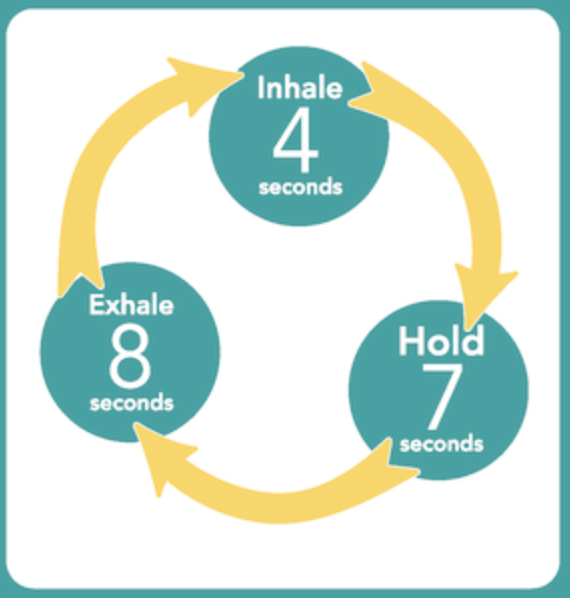
Inhale — 1, 2, 3, 4.
Exhale — 1, 2, 3, 4.
Continue for a couple of minutes, keeping your attention on the rhythm.
If your mind wanders, notice that it wandered.
Then return to the next breath.
That’s it.
The practice isn’t about having a completely empty mind.
It is about noticing when your attention has moved away and gently bringing it back.
Breath counting is one of the practices suggested in the source article for supporting mental wellbeing, with the emphasis placed on using the breath as a tangible object of attention. citeturn1view0
And there is something important hidden in that simplicity:
2. Experiment with a longer exhalation
The breath can also become a way of exploring how different breathing patterns affect your experience.
One simple practice is to make the exhalation slightly longer than the inhalation.
For example:
Inhale for 4.
Exhale for 6.
There is no prize for making the numbers bigger.
The breath should remain comfortable and unforced.
If counting to four and six feels uncomfortable, use smaller numbers—or simply return to natural breathing.
Using a longer exhalation as a way of bringing attention to the breath and encouraging a calmer state.
But don’t turn this into another performance goal.
The purpose isn’t:
“How long can I make my exhalation?”
The more useful question is:
“What happens when I pay attention to my breathing instead of automatically reacting to everything around me?”
That shift in attention is part of the practice.
3. Notice instead of immediately reacting
This may be the hardest practice of all.
Something happens.
A thought appears.
An emotion comes up.
And our usual response is immediate:
React.
We don’t simply experience anger.
We become the anger.
We don’t simply notice worry.
We start following every thought that worry produces.
Mindful awareness introduces a small space between experiencing something and automatically becoming involved in it.
Try this.
Sit quietly for a few minutes.
Notice sounds around you.
Notice sensations in your body.
Notice the movement of your breath.
Then notice your thoughts.
You don’t have to fight them.
You don’t have to force them away.
You don’t have to analyze every thought.
Just notice:
“There is a thought.”
Then let it move on.
Another thought appears.
Notice it.
Another sensation appears.
Notice that too.
The source article similarly uses sensory awareness and observation of thoughts as a way of bringing attention back to the present moment.
This sounds simple.
It isn’t always easy.
Because most of us have spent years practicing the opposite:
Following every thought our mind produces.
Yoga gives us opportunities to practice something different.
Observing without immediately reacting.
4. Move—but actually pay attention while you move
Sometimes the mind is too restless for stillness.
You sit down to meditate and discover that your thoughts have apparently decided to hold a meeting.
In those moments, movement can become the doorway into awareness.
Instead of rushing through your practice, slow down.
Feel your feet.
Notice the movement of your spine.
Pay attention to the transition between postures.
Notice the breath.
Notice where you are holding unnecessary tension.
You could move through a few rounds of Surya Namaskar.
You could practice a slower sequence.
You could simply spend a few minutes moving gently with your breath.
The important part is not how impressive the movement looks.
It is where your attention is while you are moving.
Mindful movement is one of the four practices highlighted in the source article, particularly as a way of reconnecting attention with the body when the mind feels overly busy.
This is where yoga becomes different from simply exercising.
Exercise can train the body.
Yoga can also ask:
Can you remain aware while the body is moving?
The deeper practice isn’t “calming down”
There is a subtle trap in the way we talk about yoga and mental wellbeing.
We often make the goal:
“I want yoga to make me feel calm.”
And sometimes it will.
But if calm becomes the only goal, we can become frustrated whenever the mind isn’t calm.
“I’ve been meditating for ten minutes. Why am I still thinking?”
“I did yoga today. Why am I still stressed?”
That’s not necessarily a failure of yoga.
It may be a misunderstanding of the practice.
Yoga doesn’t require you to become a person who never experiences stress, frustration, sadness, anger or restless thoughts.
A deeper practice is learning to notice your experience more clearly.
To notice the breath.
To notice tension.
To notice distraction.
To notice thought patterns.
To notice your reactions.
And gradually, to develop a little more choice in how you respond.
That is a more realistic—and more interesting—way to think about mental wellbeing.
Yoga gives you a toolbox, not a single solution
There is no universal yoga practice that everyone needs.
Some days, movement may help.
Some days, sitting quietly may be appropriate.
Sometimes, working with the breath may be useful.
Sometimes, studying yoga philosophy may change the way you understand an experience.
This is one reason it is limiting to define yoga only through physical postures.
The yogic tradition contains multiple approaches to practice, including physical practice, pranayama, meditation and philosophical inquiry.
The question becomes:
What does this moment require?
Not:
“What is the one yoga pose that will fix me?”
That shift—from searching for a quick fix to developing a practice—is important.
Start smaller than you think
You don’t need to redesign your entire life tomorrow morning.
Try this instead.
Tomorrow, before opening your phone:
Take five conscious breaths.
Feel the inhalation.
Feel the exhalation.
Notice where your attention goes.
Bring it back.
Then continue with your day.
Later, when you notice your mind becoming scattered, pause for another minute.
Feel your feet.
Notice your breath.
Observe what is happening.
You may not feel dramatically different.
That’s okay.
The point isn’t to manufacture a particular emotional state.
The point is to practice awareness.
And awareness is something that can be practiced repeatedly—in formal yoga practice and in ordinary life.
Yoga for mental wellbeing begins when the practice leaves the mat
The real test of yoga isn’t always what happens during the final relaxation of a class.
It is what happens when someone irritates you.
When plans change.
When work becomes overwhelming.
When you receive a message you don’t like.
When your mind starts replaying an old conversation.
Can you notice your breath?
Can you notice your reaction?
Can you pause before responding?
Can you return your attention to the present?
That is where yoga becomes more than a workout.
It becomes a way of relating to your own experience.
And perhaps that’s one of the most valuable things a yoga practice can offer:
not a life without difficult thoughts and emotions, but a greater capacity to meet them with awareness.
A note on mental health
Yoga can be a useful part of a broader approach to wellbeing, but it should not be presented as a replacement for qualified mental-health care.
If you are experiencing persistent or severe psychological distress, seek appropriate professional support. Do not stop or change prescribed treatment because of something you read about yoga. The source article makes the same distinction between yoga as a complementary practice and professional mental-health treatment.

 Arabic
 French
 Spanish
 Portuguese
 Deutsch
 Turkish
 Dutch
Dutch
 Italiano
 Russian
 Romaian
 Portuguese (Brazil)
 Greek
Greek